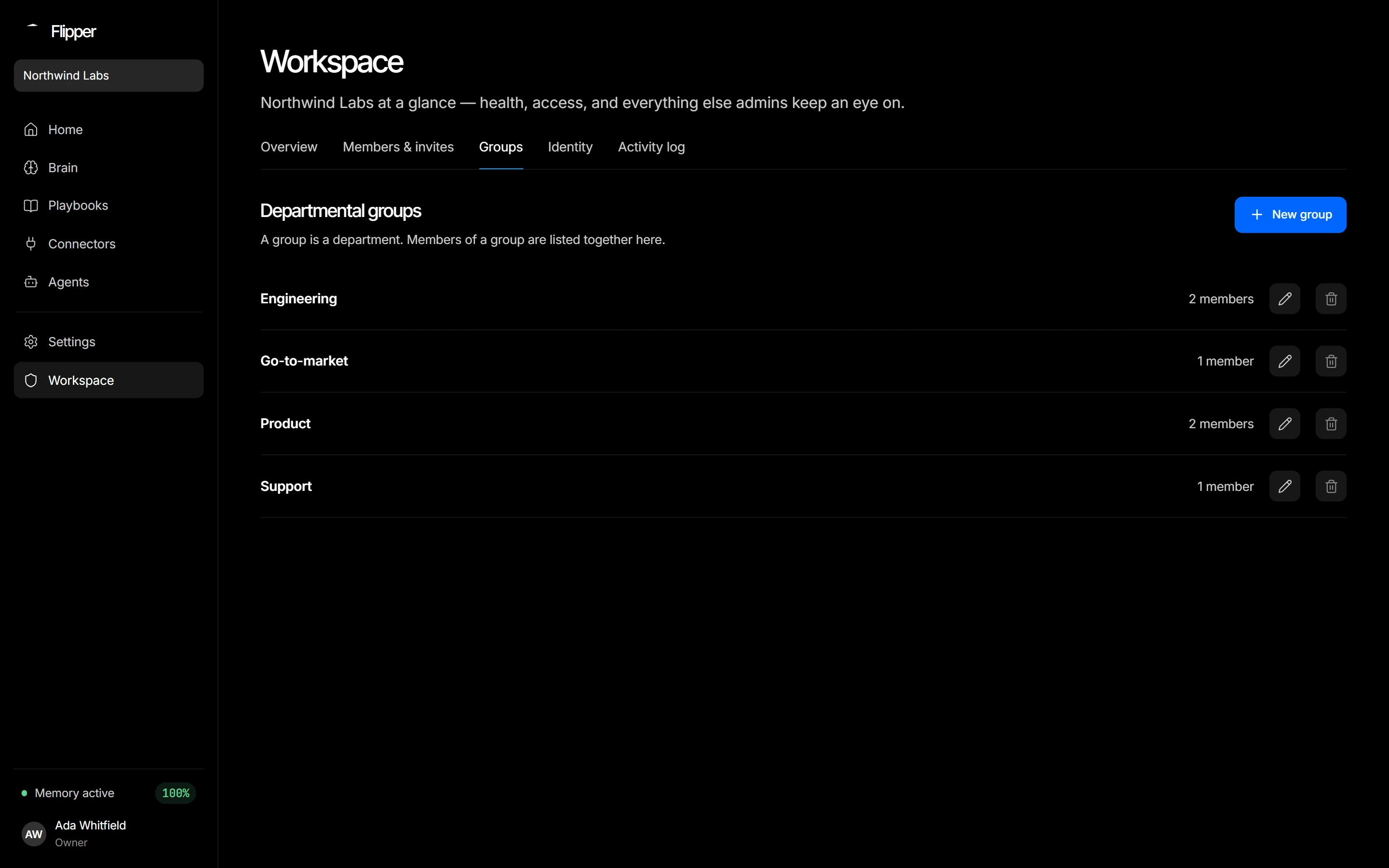
Groups
Groups are your departments — Engineering, Go-to-market, Leadership. Flipper AI files what it reads under them. Everyone in the workspace sees every department, on every plan.
What groups do today
They label what Flipper AI has read by department. They don't change who sees it: sensitivity and roles decide that.
Tagging is content-level, passage by passage
Each passage is tagged by what it is about, not by the connector it arrived through. One Notion workspace holding both Finance and Marketing pages tags each page with the department that page belongs to — and a sales page whose last section is the marketing budget files that section under Marketing and the rest under Sales. The connector's own group mapping is only the fallback, used when the content does not say — so a piece of work that spans the company, or that cannot be placed, stays as wide as its source already was.
The teams you name in the interview are set up as groups during onboarding, whether you start with one of them or open Flipper AI to the whole company. One group is enough for this to work: every passage is still judged against it, and what doesn't belong stays out rather than being swept in. A passage about a department that does not exist yet is remembered as what it is, and filed the day such a department exists — nothing is re-read.
Anything that can't be placed goes to an admin
What neither the content nor the source can place lands ungrouped. That is a queue, not a resting state: Governance shows an admin how many items are waiting and lets them allocate each one in a click. On Team and above the same screen offers the departments Flipper AI keeps finding that you haven't set up — create one, or file the name under a group you already have, and everything that read as it is placed.
Those allocations are the training signal. Flipper AI feeds an admin's own past decisions back into the next classification, so it learns how your company files things — that #launch-eu is go-to-market, that the board pack is leadership — without anyone writing a rule.