
What is Flipper AI
Flipper AI reads the places your team already works — Slack, Gmail, Drive, Calendar, Notion, Jira, Trello, GitHub — and turns the work behind each customer account into a sourced brief of status, risks, decisions and deadlines that your team can check and correct. Your AI agents get the same context over MCP. It is not another chat window.
The problem it solves
Every agent you use starts from zero. You re-explain the project, the customer, the decision you made last Tuesday, and the agent still answers like a stranger who joined this morning. The context exists — it is just scattered across five tools and nobody's head.
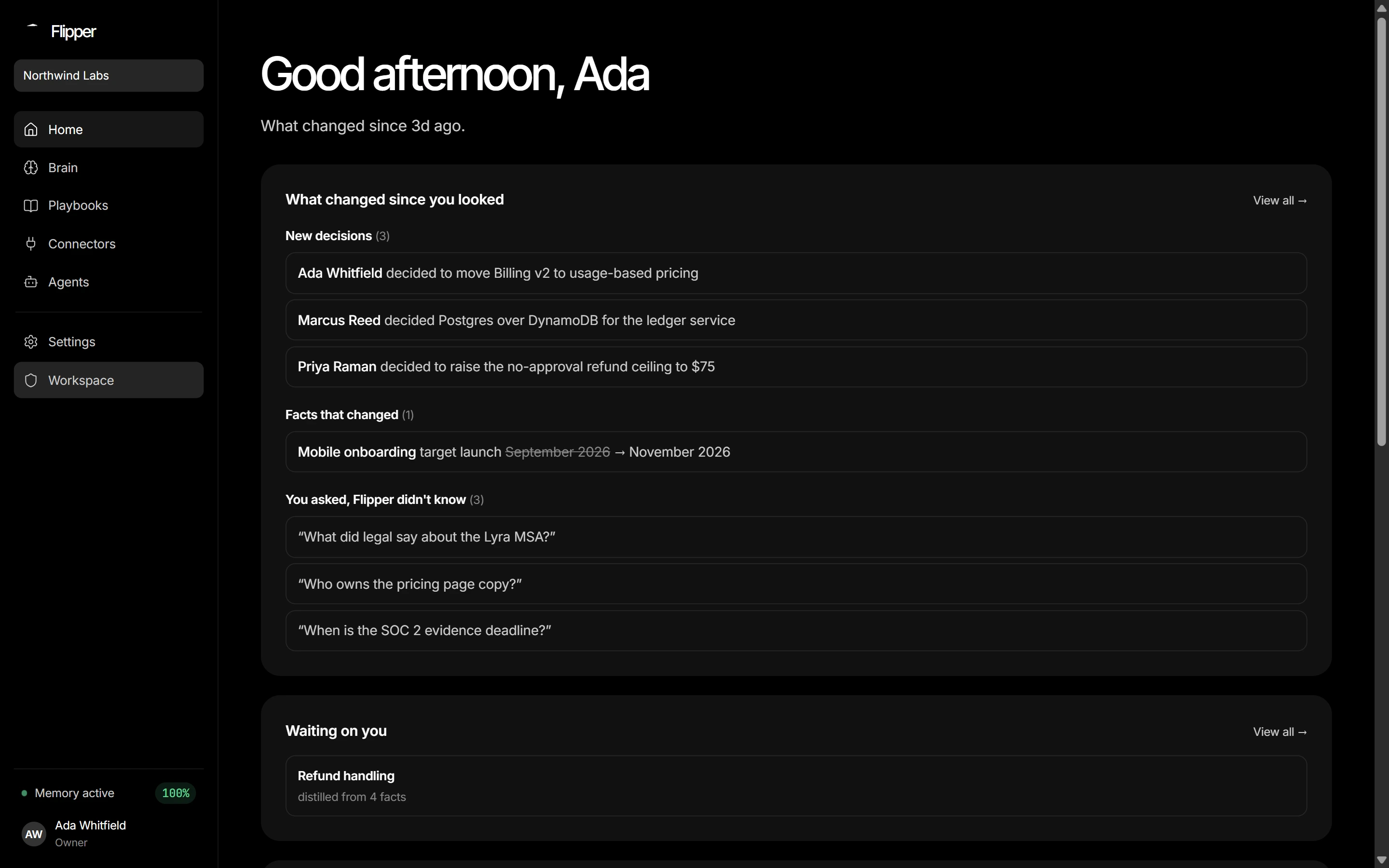
Flipper AI ingests those sources continuously, distils them into subject–predicate–object facts with confidence and provenance, and serves them over MCP. Any MCP-capable agent — Claude Code, Cursor, Codex, Claude.ai, ChatGPT — calls get_context and starts the conversation already knowing your team.
What it is not
Not a chatbot. Flipper AI has no chat interface of its own. Your agent is the interface.
Not a search box bolted onto your files. Facts are extracted and versioned, so a superseded decision is visibly superseded rather than returned alongside its replacement.
Not an autonomous actor. Flipper AI drafts with
propose_action; your agent executes under its own credentials. Flipper AI never sends an email or posts a message.